
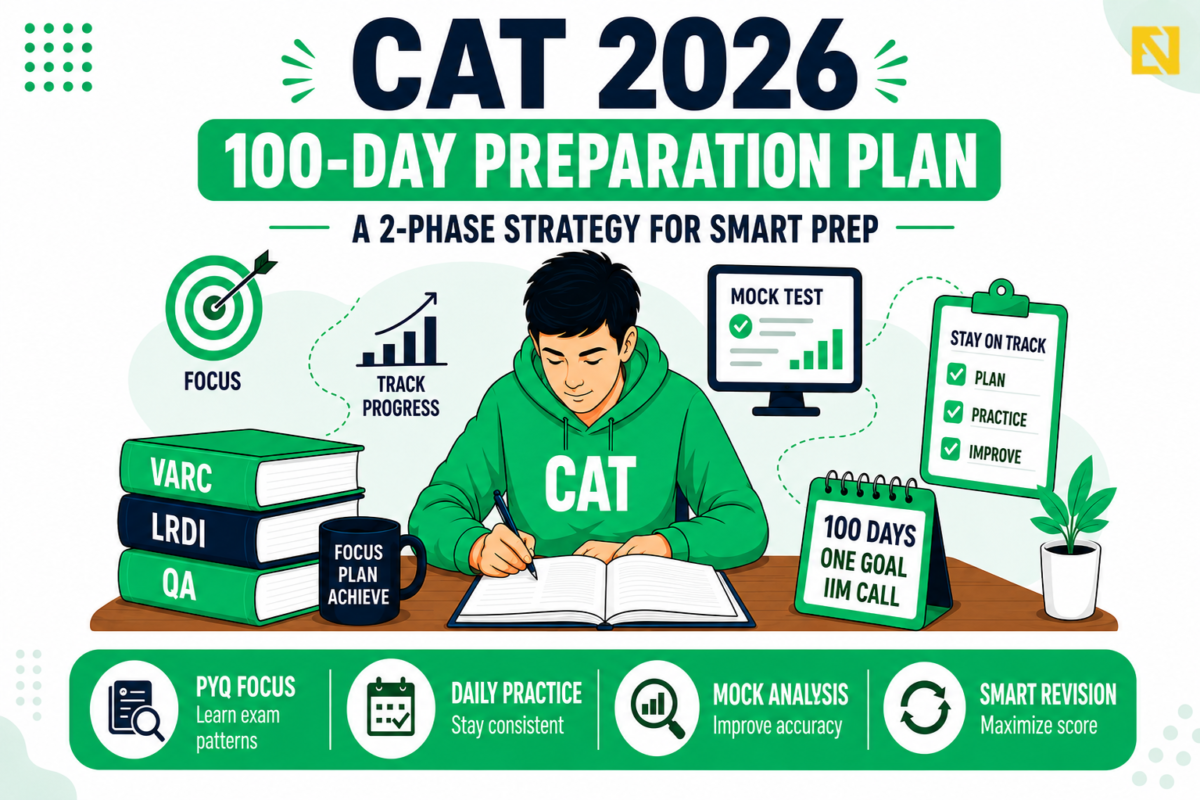
CAT is a highly competitive exam for aspirants willing to make a career in business management. This exam tests your concepts and decision-making skills.
Now that only 100 days remain until the exam, it is important to follow a structured strategy. You should know which questions to select, improve your speed and accuracy, and manage your time effectively.
In this blog, we have shared a 100-day preparation plan for those aspirants who want to prepare strategically in a limited time.
CAT 2026 Preparation Strategy: What You Need to Focus On?
Ask yourself a simple question at this stage:
Should I follow the traditional path for CAT preparation – building concepts first, then solving easy-to-moderate sectional tests, and finally practicing high-level mock tests – or should I work on an out-of-the-box plan that is more dynamic and result-oriented?
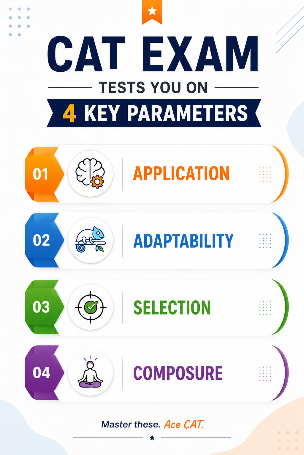
The CAT exam has always been challenging and tests you on four key parameters:
- Application: How well you apply your subject knowledge during the test.
- Adaptability: How quickly you find solutions to questions you feel unsure about.
- Selection: How quickly you pick easy questions, sets, or passages while avoiding tough ones.
- Composure: How well you control your emotions and stay focused on your goal.
If we look at the various sections in the CAT exam, certain key observations emerge.
VARC:
Reading comprehension passages cover diverse topics, and the questions are mostly inference-based with very similar options. Questions on para jumbles and odd-one-out are tricky and consume extra time.
Questions on the essence of the text and para completion have a moderate difficulty level and can be cracked easily.
DILR:
The sets from logical reasoning and data interpretation are unique. If you decode the key information, you can solve most sets within 10 minutes.
Your ability to identify easy sets and solve them early is the key to scoring high in this section.
QA:
Questions asked in quant come from 12 to 16 different topics, with at most four questions from any single topic.
Because most questions are application-based, simply memorizing formulas or rules will not help much.
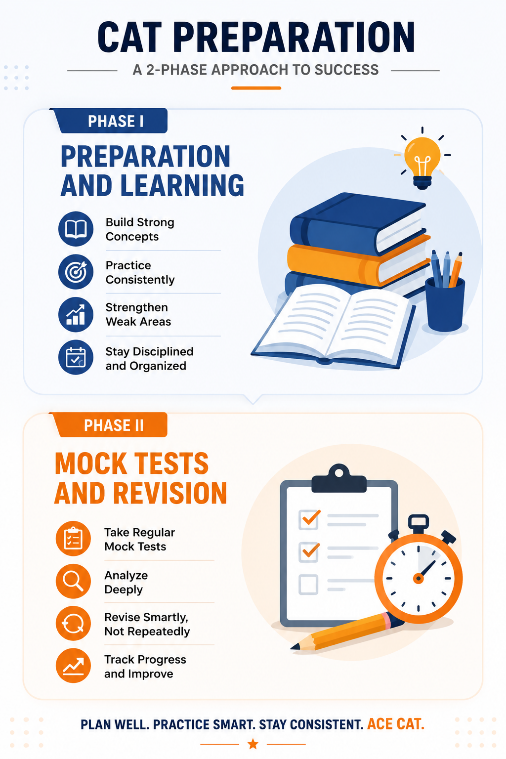
CAT 2026 Study Plan: A Two-Phase Approach
To maximize your CAT score, you need to work on a two-phase study plan that divides 100 days into a 3:2 ratio.
In the first phase (60 days), the focus must be on solving PYQs, understanding the test pattern, and building concepts as needed.
In the second phase (40 days), the focus shifts to challenging your preparation through tests, learning key test-taking strategies, and revision. However, taking mock tests will start from the very first day you begin your preparation.
Phase I: Preparation and Learning
Daily schedule: Prepare a daily schedule and dedicate specific hours to address the various sections asked in the CAT exam.
- Quantitative Aptitude (QA): You need to prepare one or two topics every week, covering easy topics from arithmetic to important ones from geometry, the number system, and algebra alternately.
Build quick concepts of the topic by dedicating a maximum of one hour to learning important rules and formulas.
Solve previous year questions (PYQs) for that topic, keeping the time limit to a maximum of four minutes per question. Look at the video solutions and memorize the concepts and approaches used.
Solve 25 to 30 relevant questions of that topic to strengthen your concepts, and solve questions in mock tests from the topics already covered.
This reverse approach will help you build a strong understanding of question patterns and learn key concepts in no time.
- Data Interpretation & Logical Reasoning (DILR): Solve two to three PYQ puzzles every day, starting from the most recent CAT papers, and dedicate a maximum of 15 minutes to each puzzle. Focus on decoding key information and building an easy solution.
Watch video solutions to learn the approach discussed and draw a mental roadmap of it. Solve two additional puzzles every day from any single DILR topic, spending no more than 10 minutes on each puzzle.
In your initial mock tests, solve one to two puzzles, and increase to two to three puzzles in later ones. While analyzing a mock test, if you find that a puzzle is unnecessarily tough or requires too many cases to be built, do not waste time trying to solve it.
- Verbal Ability (VA): Write two to three verbal ability sections from previous CAT papers as a test, dedicating 40 minutes to each test. Focus on the key message in each paragraph, and prepare a summary for each passage.
Read additional relevant material about the topic to understand the core idea and become comfortable with it. This will also help you answer paragraph-completion and text-essence questions with confidence, build logical connections in parajumbles and odd-one-out questions, and develop general and diversified reading habits.
Solve two to three Reading Comprehension (RC) passages every day under a strict time limit of 10 minutes each, along with 10 to 15 questions from other verbal ability areas asked in the CAT.
While taking mock tests, compare the level of the questions with those of the actual CAT paper, decide on the expected cut-off and a good score, and adjust your speed accordingly.
Phase II: Mock Tests and Revision
Mock Frequency:
In the last forty days, write three to four complete mock tests and eight to ten quality sectional tests every week.
Test Strategy:
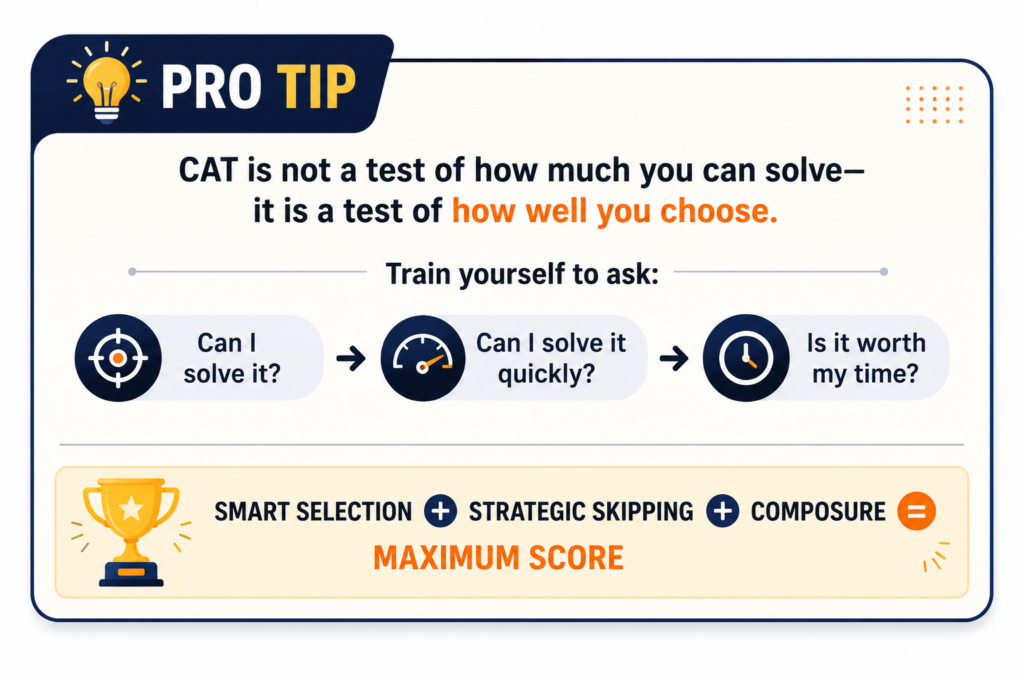
During the test, focus on selecting easy questions, sets, and passages, and answering them quickly with high accuracy. After the test, analyze it thoroughly, identify key areas to be worked upon, and concepts to be revised.
Daily Revision:
Pick one or two topics every day and revise the concepts, rules, and formulas. Keep realistic targets in mind and take small steps to score higher as the CAT approaches.
Practice and Mindset:
Keep reading quality articles. Pick PYQs that you have already done and solve them under a stricter time limit this time. Most importantly, enjoy your preparation and find solutions to the challenges faced.
Strategic Skipping:
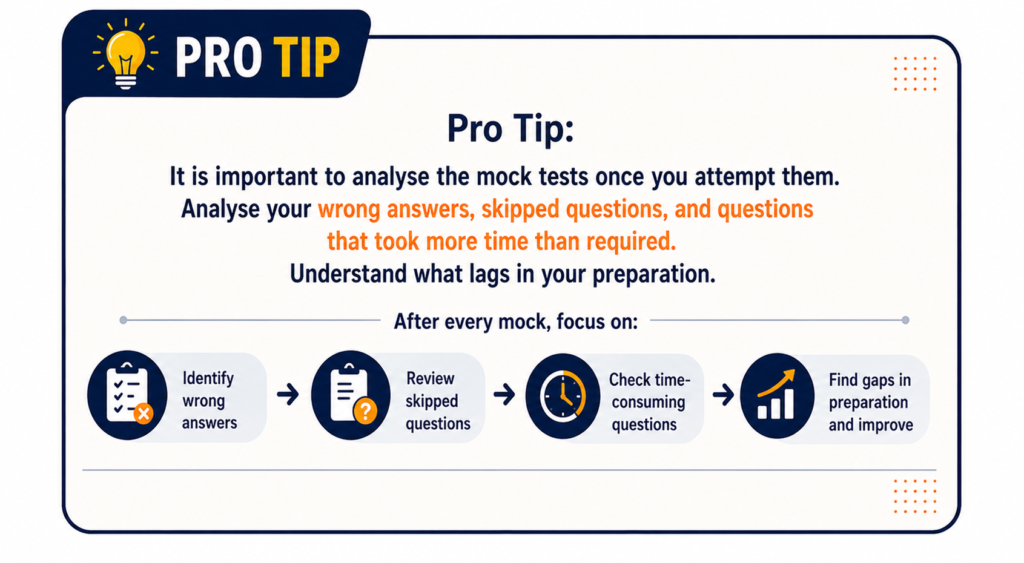
If a certain area or topic is too challenging for you, leave it and focus more on manageable ones. Remember, the CAT is not about solving everything; it is about identifying and solving easier questions and skipping tougher ones. This will help you maximize your score with less effort.
Conclusion
For a CAT aspirant who is preparing strategically and consistently, 100 days are more than enough. Your main focus should be on solving previous year questions, taking mock tests, and analysing your preparation. The aspirants should know how to attempt the exam smartly within the available time. With consistent preparation and a calm mind, you can ace the exam.
FAQs
- Should I start taking mock tests before completing the syllabus?
The questions asked in the CAT exam are application-based. Writing mock tests at this stage will help you focus your efforts on the variations asked in questions, instead of doing everything, which in turn will increase your overall score.
- How many mock tests should I take in the last 40 days?
Writing 20 to 25 quality mock tests, followed by analyzing each test and fixing your weak areas, will be enough. You can also add 10 to 15 sectional tests.
- What should I do if I am weak in a particular CAT section or topic?
Learn the rules, formulas, and basic variations of every topic. If an easy question appears from a weak area, you can still score points. For tough sections, practice many questions and memorize the approaches to secure a high score.